

Table of Contents
- What Are the Different Types of Travel Websites?
- How These Types Map to Content Needs
- Why the Old “Just Publish Guides & Blogs” Playbook Fails Now
- The Hub-and-Spoke Model — How New Travel Sites Win
- Why “Programmatic” Is the Travel Site’s Unfair Advantage
- Choosing Your Attack Axis — Three Variant Plays
- Sequencing the Build — Start Where It Compounds
- Making the Cluster AI-Citation-Ready
- The Strategy in One Line
"Travel website" is a single label stretched across very different businesses — a global booking engine, a price-comparison tool, an official tourism board, a one-person blog. Each type exists to do a different job, and each one wins on a completely different kind of content. This guide first lays out the main types of travel websites and how they're classified, then shows you the content strategy that actually lets a new travel site break through in a market dominated by giants.
What Are the Different Types of Travel Websites?
Travel websites are generally classified by the primary job they do for the traveller. There are seven main types: online travel agencies (OTAs), metasearch and comparison sites, direct booking sites, tour operator and DMC sites, destination and tourism board sites (DMOs), travel blogs and content sites, and review and community platforms. Each sits at a different point in the traveller's journey — from early inspiration, through research and comparison, to the final booking — and that position determines the kind of content it lives or dies by.
Online Travel Agencies (OTAs)
OTAs let travellers search, compare, and book flights, hotels, and packages in one place, earning commission on each booking. Examples: Booking.com, Expedia, Agoda, MakeMyTrip, Yatra, Cleartrip. They own the highest-value transactional keywords and operate at enormous scale, which makes them the hardest type for a newcomer to compete with head-on.
Metasearch & Comparison Sites
Metasearch engines don't sell the booking themselves — they aggregate prices from OTAs and suppliers so travellers can compare, then hand off to the seller. Examples: Kayak, Skyscanner, Trivago, Google Flights, Momondo. Their content is fundamentally data-driven: live prices, routes, and availability rather than prose.
Direct Booking Sites
These are the first-party sites of individual hotels, airlines, resorts, and chains, built to take bookings directly and bypass OTA commissions. Examples: marriott.com, tajhotels.com, indigo.in, emirates.com. Their content job is to convert visitors who already know the brand, and increasingly to win direct search demand the OTAs would otherwise capture.
Tour Operator & DMC Sites
Tour operators and destination management companies (DMCs) sell packaged experiences — curated itineraries, guided tours, and multi-day trips. Examples: Thomas Cook, Veena World, SOTC, TravelTriangle, Thrillophilia. Their sites lean on rich itinerary content, experience descriptions, and trust signals, because they're selling a planned outcome rather than a single room or seat.
Destination & Tourism Board Sites (DMOs)
Destination marketing organisations — official tourism boards for a country, state, or city — exist to attract visitors rather than sell directly. Examples: incredibleindia.org, visitbritain.com, australia.com, keralatourism.org. Their content is authoritative, comprehensive destination information, and they carry strong trust and authority signals that other site types often link to.
Travel Blogs & Content Sites
Blogs and editorial travel media win through inspiration, storytelling, and practical guides, ranging from solo creators to large publishers. Examples: Lonely Planet, Nomadic Matt, The Points Guy, Travel + Leisure, and countless independent niche blogs. This is the type most reliant on genuine first-hand experience — and, as we'll see, the type with the most room for a smart content strategy to break through.
Review & Community Platforms
Review sites and forums are powered by user-generated content. Examples: TripAdvisor, the r/travel and r/solotravel communities on Reddit, Lonely Planet's Thorn Tree forum. Their value compounds with every review and thread, creating a moat of crowd-sourced depth that's almost impossible to replicate from scratch.
How These Types Map to Content Needs
Knowing the type isn't academic — it dictates the content strategy. Each website type has a dominant content job, and getting that job wrong is the most common reason travel content underperforms. Here's the map:
| Website Type | Primary Content Job | Dominant Intent |
|---|---|---|
| OTA | Convert searches into bookings at scale | Transactional |
| Metasearch | Compare options on live data | Comparison |
| Direct booking | Convert brand-aware visitors | Transactional |
| Tour operator / DMC | Sell curated experiences via itineraries | Comparison / inspiration |
| DMO | Inform and attract to a destination | Informational |
| Travel blog / content | Inspire and guide with first-hand depth | Inspiration / education |
| Review / community | Aggregate trustworthy peer opinion | Research / validation |
If you're building or growing any site in the bottom four rows — operators, DMOs, blogs, content sites — the rest of this guide is for you. These are the types where a deliberate content strategy, rather than raw budget, decides who wins. And the giants in the top rows have left more room than you'd think.
Why the Old "Just Publish Guides & Blogs" Playbook Fails Now
For years, the advice for a new travel site was simple: write city guides for SEO, write blog posts for engagement, repeat. That playbook is now broken, for three reasons.
First, the head terms are owned. Search "things to do in Bali" or "best hotels in Goa" and the first page is wall-to-wall OTAs, TripAdvisor, and established media. A new site has no realistic path to outrank them on those terms with another generic guide.
Second, AI Overviews now eat the top of the page. A large and growing share of travel searches return an AI-generated summary before any blue link, and many of those searches end without a click at all. Generic content that merely restates what's already known gets absorbed into the summary and never seen.
Third, generic content is now a liability, not just weak. Search engines have become good at detecting thin, experience-free travel content — and recent algorithm updates have hit it hard while rewarding pages that show genuine first-hand depth. Publishing another me-too guide doesn't just fail to rank; it can drag your whole site's quality signal down.
The only durable opening left is structured depth on the specific — and that's exactly what the hub-and-spoke model is built to capture.
The Hub-and-Spoke Model — How New Travel Sites Win
Hub-and-spoke is a content architecture, not a single article. A hub is a comprehensive pillar page on a broad topic. Spokes are many tightly-focused pages that each answer one specific question, all linked back to the hub and to each other. Instead of one thin guide trying to cover everything, you build a dense, interconnected cluster that signals to both Google and AI engines that you are the reference source on that topic.
The logic is simple: you can't beat Booking.com on "Bali hotels," but you absolutely can own "is the Bali airport to Ubud taxi worth it in monsoon season" — and a thousand questions like it. Win enough of the specific, and the cluster's authority eventually lifts you toward the broader terms too.
What Makes a Strong Hub
A strong hub page covers a broad topic comprehensively — say, "The Complete Guide to Visiting Coorg" — and acts as the table of contents for everything beneath it. It targets the broad head term, gives a genuinely useful overview, and links out to every spoke that covers a sub-topic in depth. It's the trunk; the spokes are the branches.
What Makes a Strong Spoke
A spoke answers exactly one specific, long-tail question and answers it better than anyone else: "best time to visit Coorg for the coffee harvest," "how to get from Bangalore to Coorg by road," "are Coorg homestays good for families with toddlers." Each spoke is low-competition on its own, but collectively they capture enormous specific demand and feed the hub's authority.
The Internal-Linking Mesh That Builds Authority
The links are what turn a pile of pages into a cluster. Every spoke links up to its hub and sideways to related spokes; the hub links down to all its spokes. This mesh distributes authority across the cluster, keeps readers moving deeper into your site, and tells search engines the pages belong together as a coherent body of expertise — the single strongest signal of topical authority you can build.
Why "Programmatic" Is the Travel Site's Unfair Advantage
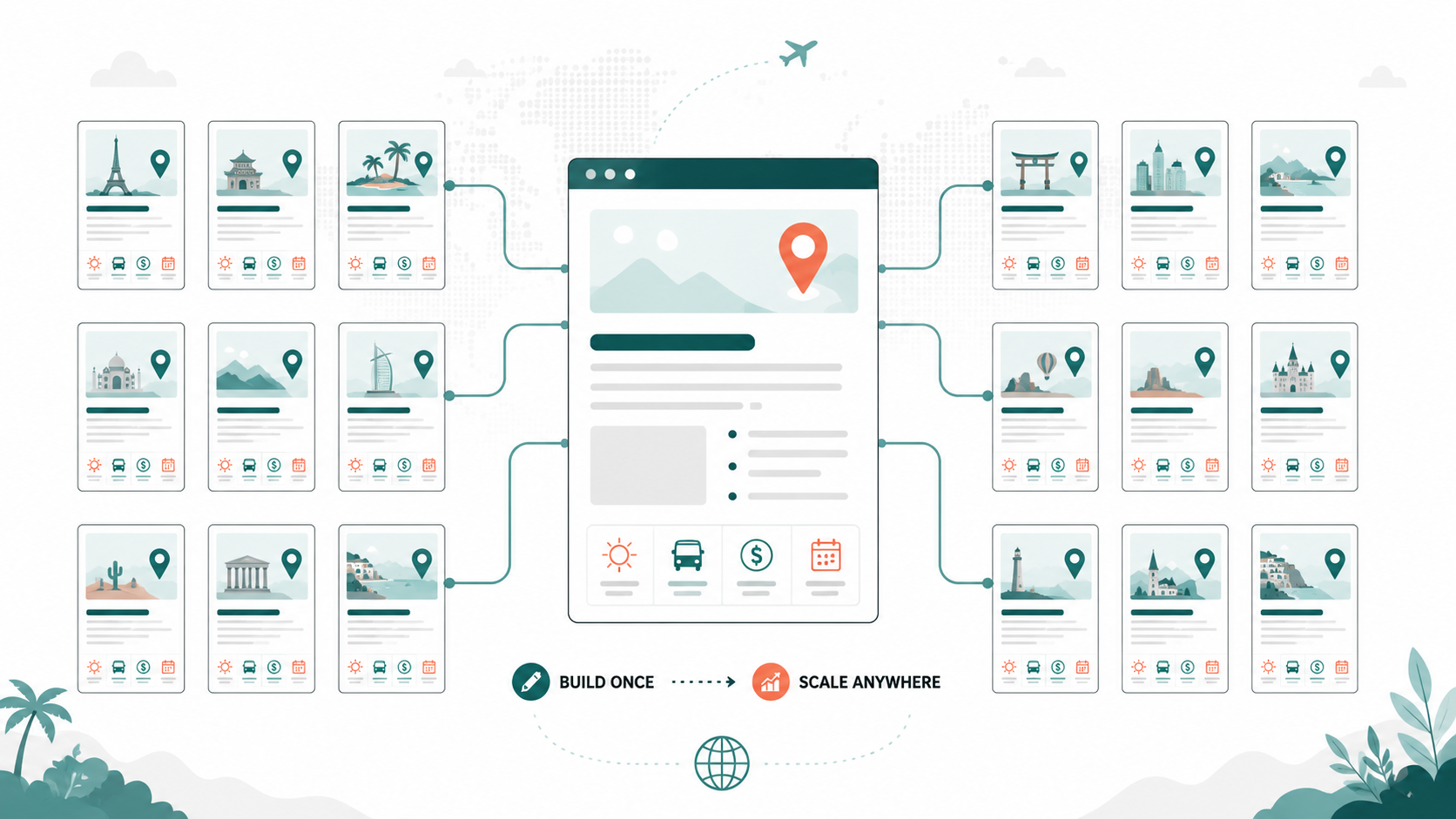
Travel is almost uniquely suited to programmatic content — building a page template once and populating it across thousands of entities. That's because the same questions repeat across every destination: "best time to visit ___," "how to get from ___ to ___," "is ___ safe for solo travellers," "___ on a budget." The question pattern is fixed; only the destination changes. This is the lever that lets a small team out-cover giant incumbents on the specific.
Finding Your Repeatable Query Patterns
Start by identifying the question templates travellers ask about every destination, then validate them against real search data. Tools like Google Search Console, keyword research platforms, and even the "People also ask" box reveal the patterns. The goal is a handful of high-frequency question templates you can apply across your entire universe of destinations.
The Template + Data Approach
Once you have a pattern, you build one excellent page structure for it and populate it with destination-specific data — weather tables, transport options, prices, distances, seasonal notes. The template guarantees consistency and scale; the data makes each page genuinely useful and distinct. This is how you produce hundreds of strong spokes without writing hundreds of articles from a blank page.
The Guardrail — Programmatic Still Needs Substance
Here's the line that separates a moat from a penalty: programmatic does not mean thin. A template filled with the same vague filler across 500 pages is a doorway-page problem that search engines punish. Every page needs real, specific substance — accurate data, genuine first-hand observation, exact details a bot couldn't invent. Programmatic gives you the scale; first-hand experience is what makes each page rank and earns AI citations. Skip the substance and the whole strategy collapses into spam.
Choosing Your Attack Axis — Three Variant Plays
A programmatic hub-and-spoke system needs one primary axis to scale along first. Pick the wrong one and you spread thin; pick the right one and the cluster compounds. There are three proven axes, and they aren't mutually exclusive — most sites lead with one to establish authority, then layer the others.
Play 1 — The Destination Ladder (Geographic)
Structure your clusters geographically: a hub per region, spokes per city, micro-spokes per neighbourhood or attraction. This is the widest-reaching axis and the most intuitive for a destination site — but also the most competitive, since it's the path most travel sites take. Best when you have deep coverage of a defined geography to offer.
Play 2 — The Traveller-Type Moat (Audience/Intent)
Instead of owning places, own a person. Pick one underserved traveller segment — solo female travellers, digital nomads, families with toddlers, accessible travel, vegetarian travellers — and answer every question that segment has, across many destinations. This axis is narrower but far more defensible: it's a natural fit for first-hand expertise, it faces less head-on competition, and it builds a loyal, returning audience the giants can't easily serve.
Play 3 — The Logistics Layer (Transactional/Utility)
Own the repetitive practical questions the giants answer lazily: routes and transport ("how to get from X to Y"), visa rules, cost breakdowns, best-time-to-visit, what to pack. These queries are high-intent, evergreen, intensely programmatic-friendly, and — because the answer is concrete and self-contained — they feed directly into AI answer boxes and featured snippets. This is often the fastest axis to show results on.
Sequencing the Build — Start Where It Compounds
The fatal mistake is going broad too early — publishing one shallow hub for fifty destinations at once. Don't boil the ocean. Build one hub and its complete set of spokes first, prove that cluster can rank, and refine the template until it works. Then replicate the proven template to the next hub, and the next. Depth-first, not breadth-first. A single fully-built cluster that ranks is worth more than fifty half-built ones that don't, and it gives you a tested blueprint to scale with confidence.
Making the Cluster AI-Citation-Ready
With AI Overviews and answer engines now sitting above the blue links, your cluster should be built to be quoted, not just ranked. A few practices make the difference:
- Self-contained answer passages. Open each spoke with a tight, complete answer to its question — the kind of short, standalone passage an AI can lift directly.
- Structured data. FAQ and Article schema help both Google's AI retrieval and independent answer engines parse and cite your content.
- First-hand experience signals. Original photography, exact prices, named local spots, and specific seasonal detail prove the content came from real experience — the thing AI can summarise but can't replicate.
- Speed and mobile. Most travel research happens on a phone; a fast, clean mobile page is now a baseline ranking and conversion factor.
Hub-and-spoke gives you the architecture; citation-readiness makes that architecture visible in both classic search and the AI answers that increasingly come first.
The Strategy in One Line
Stop competing for the words everyone wants. Identify your travel-website type, then programmatically own the thousands of specific questions the giants can't be bothered to answer well — built on real first-hand substance, stitched into clusters, and structured to be cited. That's how a new travel site wins the search game in 2026, and it's the difference between a site that publishes content and one that builds an asset.
Building that kind of structured, experience-grounded content programme at scale is exactly the work a specialist content team does day in, day out. If you'd rather have it built for you, Fellocraft's travel writing services have produced research-led content for travel and hospitality brands for two decades.
 Need a writing partner?


Was this page helpful?